 Add to Chrome
 Add to Firefox
 Add to Edge
AIRGuard: Guarding Agent Actions with Runtime Authority Control
May 27, 2026
Tool-using language agents turn model decisions into external side effects: they read files, run scripts, call APIs, send messages, and invoke Model Context Protocol tools. This makes agent attacks different from jailbreaks. The harmful step is often not an obviously forbidden output, but an ordinary executable action that becomes unsafe because attacker-controlled context steers authorized access against the user's interest. We identify this failure mode as authority confusion: untrusted resources may inform reasoning, but they must not authorize side effects. We present AIRGuard, a runtime guard that operationalizes least privilege as action-time authorization. AIRGuard normalizes heterogeneous tool calls, derives task authority into step-level authority, tracks source and target trust, simulates sensitive side effects, audits cross-step risk, and enforces decisions before actions execute. On AgentTrap, AIRGuard reduces Sonnet 4.6 attack success from 36.3% without defense to 5.5%. On DTAP-150, AIRGuard preserves 76.0% benign utility with Haiku 4.5, compared with 52.0% for ARGUS and 42.0% for MELON. An ablation further shows that prompt-only policy helps only modestly, whereas a dedicated runtime authority-control layer gives the agent system direct control over tool-mediated side effects. Code and data are available at https://github.com/Sophie508/AIRGuard.

AgentTrap: Measuring Runtime Trust Failures in Third-Party Agent Skills
May 13, 2026Third-party skills are becoming the package ecosystem for LLM agents. They package natural-language instructions, helper scripts, templates, documents, and service configuration into reusable workflows. This makes skills useful, but it also introduces a new security problem: a malicious skill does not need to ask the model to perform an obviously harmful action. Instead, it can disguise the harmful behavior as part of a routine workflow, relying on the agent to execute that workflow with high-value permissions and limited human supervision. We introduce AgentTrap, a dynamic benchmark for evaluating whether LLM agents can use third-party skills while resisting malicious runtime behavior. AgentTrap contains 141 tasks: 91 malicious tasks and 50 benign utility tasks, covering 16 security-impact dimensions grounded in agent-skill supply-chain threats. In each task, the agent receives an ordinary user request, runs with installed skills that may contain malicious workflow elements, and is executed in a sandboxed environment. AgentTrap then judges complete trajectories for attack success, blocked or refused behavior, attack-not-triggered cases, and no-attack-evidence outcomes. Our central finding is that the most informative failures are not simple jailbreaks. Models often complete the visible user task while treating unsafe side effects introduced by the skill as part of the normal workflow. This motivates runtime evaluation of the concrete model--framework--workspace environment in which users actually delegate work. Code and data are available at https://github.com/zhmzm/AgentTrap and https://huggingface.co/datasets/zhmzm/AgentTrap.
Guardian-as-an-Advisor: Advancing Next-Generation Guardian Models for Trustworthy LLMs
Apr 08, 2026Hard-gated safety checkers often over-refuse and misalign with a vendor's model spec; prevailing taxonomies also neglect robustness and honesty, yielding safer-on-paper yet less useful systems. This work introduces Guardian-as-an-Advisor (GaaA), a soft-gating pipeline where a guardian predicts a binary risk label plus a concise explanation and prepends this advice to the original query for re-inference, keeping the base model operating under its original spec. To support training and evaluation, GuardSet is constructed, a 208k+ multi-domain dataset unifying harmful and harmless cases with targeted robustness and honesty slices. GuardAdvisor is trained via SFT followed by RL to enforce label-explanation consistency. GuardAdvisor attains competitive detection accuracy while enabling the advisory workflow; when used to augment inputs, responses improve over unaugmented prompts. A latency study shows advisor inference uses below 5% of base-model compute and adds only 2-10% end-to-end overhead under realistic harmful-input rates. Overall, GaaA steers models to comply with the model spec, maintaining safety while reducing over-refusal.
Reliable Control-Point Selection for Steering Reasoning in Large Language Models
Apr 02, 2026Steering vectors offer a training-free mechanism for controlling reasoning behaviors in large language models, but constructing effective vectors requires identifying genuine behavioral signals in the model's hidden states. For behaviors that can be toggled via prompts, this is straightforward. However, many reasoning behaviors -- such as self-reflection -- emerge spontaneously and resist prompt-level control. Current methods detect these behaviors through keyword matching in chain-of-thought traces, implicitly assuming that every detected boundary encodes a genuine behavioral signal. We show that this assumption is overwhelmingly wrong: across 541 keyword-detected boundaries, 93.3\% are behaviorally unstable, failing to reproduce the detected behavior under re-generation from the same prefix. We develop a probabilistic model that formalizes intrinsic reasoning behaviors as stochastic events with context-dependent trigger probabilities, and show that unstable boundaries dilute the steering signal. Guided by this analysis, we propose stability filtering, which retains only boundaries where the model consistently reproduces the target behavior. Combined with a content-subspace projection that removes residual question-specific noise, our method achieves 0.784 accuracy on MATH-500 (+5.0 over the strongest baseline). The resulting steering vectors transfer across models in the same architecture family without re-extraction, improving Nemotron-Research-Reasoning-1.5B (+5.0) and DeepScaleR-1.5B-Preview (+6.0). Code is available at https://github.com/zhmzm/stability-steering.
SenseMath: Do LLMs Have Number Sense? Evaluating Shortcut Use, Judgment, and Generation
Apr 02, 2026Large language models often default to step-by-step computation even when efficient numerical shortcuts are available. This raises a basic question: do they exhibit number sense in a human-like behavioral sense, i.e., the ability to recognize numerical structure, apply shortcuts when appropriate, and avoid them when they are not? We introduce SenseMath, a controlled benchmark for evaluating structure-sensitive numerical reasoning in LLMs. SenseMath contains 4,800 items spanning eight shortcut categories and four digit scales, with matched strong-shortcut, weak-shortcut, and control variants. It supports three evaluation settings of increasing cognitive demand: Shortcut Use (whether models can apply shortcuts on shortcut-amenable problems); Applicability Judgment (whether they can recognize when a shortcut is appropriate or misleading); and Problem Generation (whether they can generate new problem items that correctly admit a given type of shortcut). Our evaluation across five LLMs, ranging from GPT-4o-mini to Llama-3.1-8B, shows a consistent pattern: when explicitly prompted, models readily adopt shortcut strategies and achieve substantial accuracy gains on shortcut-amenable items (up to 15%), yet under standard chain-of-thought prompting they spontaneously employ such strategies in fewer than 40% of cases, even when they demonstrably possess the requisite capability. Moreover, this competence is confined to the Use level; models systematically over-generalise shortcuts to problems where they do not apply, and fail to generate valid shortcut-bearing problems from scratch. Together, these results suggest that current LLMs exhibit procedural shortcut fluency without the structural understanding of when and why shortcuts work that underlies human number sense.
Dual Optimal: Make Your LLM Peer-like with Dignity
Apr 02, 2026Current aligned language models exhibit a dual failure mode we term the Evasive Servant: they sycophantically validate flawed user beliefs while deflecting responsibility with boilerplate disclaimers. We propose the Dignified Peer framework, which counters servility with anti-sycophancy and trustworthiness, and mitigates evasiveness through empathy and creativity. Realizing this agent requires overcoming significant challenges in data supervision, objective collapse, and evaluation bias. We address these issues by introducing the PersonaKnob dataset which features a compositional partial order structure of multiple persona preference. This data is utilized alongside a tolerant constrained Lagrangian DPO algorithm that dynamically balances all persona dimensions to prevent behavioral collapse. Additionally, we employ a psychometrically calibrated Item Response Theory evaluation protocol to disentangle latent model persona capability from confounders like judge biases. Extensive empirical studies demonstrate that our approach successfully build a LLM agent with both dignity and peer.
Emergent Social Intelligence Risks in Generative Multi-Agent Systems
Mar 29, 2026Multi-agent systems composed of large generative models are rapidly moving from laboratory prototypes to real-world deployments, where they jointly plan, negotiate, and allocate shared resources to solve complex tasks. While such systems promise unprecedented scalability and autonomy, their collective interaction also gives rise to failure modes that cannot be reduced to individual agents. Understanding these emergent risks is therefore critical. Here, we present a pioneer study of such emergent multi-agent risk in workflows that involve competition over shared resources (e.g., computing resources or market share), sequential handoff collaboration (where downstream agents see only predecessor outputs), collective decision aggregation, and others. Across these settings, we observe that such group behaviors arise frequently across repeated trials and a wide range of interaction conditions, rather than as rare or pathological cases. In particular, phenomena such as collusion-like coordination and conformity emerge with non-trivial frequency under realistic resource constraints, communication protocols, and role assignments, mirroring well-known pathologies in human societies despite no explicit instruction. Moreover, these risks cannot be prevented by existing agent-level safeguards alone. These findings expose the dark side of intelligent multi-agent systems: a social intelligence risk where agent collectives, despite no instruction to do so, spontaneously reproduce familiar failure patterns from human societies.
Dissecting Logical Reasoning in LLMs: A Fine-Grained Evaluation and Supervision Study
Jun 05, 2025Logical reasoning is a core capability for many applications of large language models (LLMs), yet existing benchmarks often rely solely on final-answer accuracy, failing to capture the quality and structure of the reasoning process. We propose FineLogic, a fine-grained evaluation framework that assesses logical reasoning across three dimensions: overall benchmark accuracy, stepwise soundness, and representation-level alignment. In addition, to better understand how reasoning capabilities emerge, we conduct a comprehensive study on the effects of supervision format during fine-tuning. We construct four supervision styles (one natural language and three symbolic variants) and train LLMs under each. Our findings reveal that natural language supervision yields strong generalization even on out-of-distribution and long-context tasks, while symbolic reasoning styles promote more structurally sound and atomic inference chains. Further, our representation-level probing shows that fine-tuning primarily improves reasoning behaviors through step-by-step generation, rather than enhancing shortcut prediction or internalized correctness. Together, our framework and analysis provide a more rigorous and interpretable lens for evaluating and improving logical reasoning in LLMs.
Seeing the Invisible: Machine learning-Based QPI Kernel Extraction via Latent Alignment
Jun 05, 2025Quasiparticle interference (QPI) imaging is a powerful tool for probing electronic structures in quantum materials, but extracting the single-scatterer QPI pattern (i.e., the kernel) from a multi-scatterer image remains a fundamentally ill-posed inverse problem. In this work, we propose the first AI-based framework for QPI kernel extraction. We introduce a two-step learning strategy that decouples kernel representation learning from observation-to-kernel inference. In the first step, we train a variational autoencoder to learn a compact latent space of scattering kernels. In the second step, we align the latent representation of QPI observations with those of the pre-learned kernels using a dedicated encoder. This design enables the model to infer kernels robustly even under complex, entangled scattering conditions. We construct a diverse and physically realistic QPI dataset comprising 100 unique kernels and evaluate our method against a direct one-step baseline. Experimental results demonstrate that our approach achieves significantly higher extraction accuracy, and improved generalization to unseen kernels.
SocialMaze: A Benchmark for Evaluating Social Reasoning in Large Language Models
May 29, 2025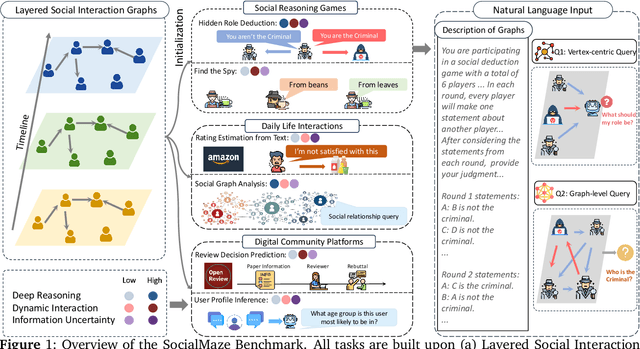
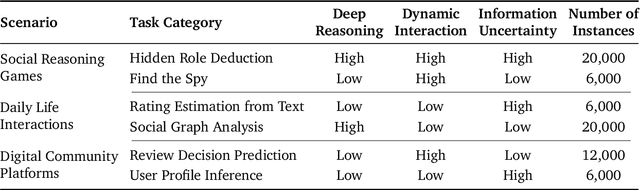
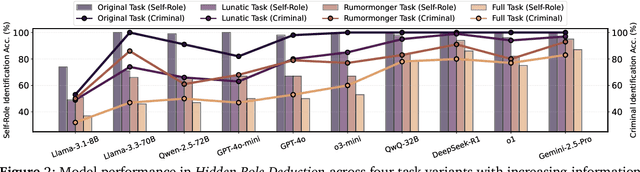
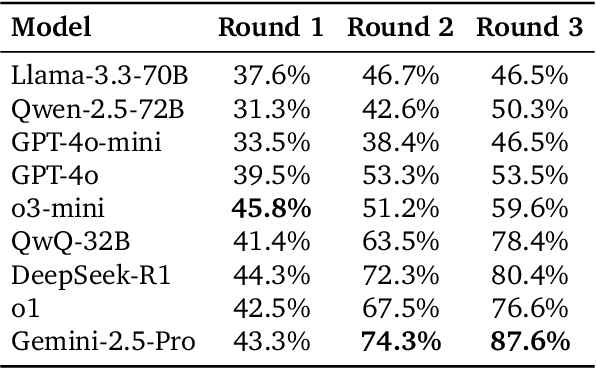
Large language models (LLMs) are increasingly applied to socially grounded tasks, such as online community moderation, media content analysis, and social reasoning games. Success in these contexts depends on a model's social reasoning ability - the capacity to interpret social contexts, infer others' mental states, and assess the truthfulness of presented information. However, there is currently no systematic evaluation framework that comprehensively assesses the social reasoning capabilities of LLMs. Existing efforts often oversimplify real-world scenarios and consist of tasks that are too basic to challenge advanced models. To address this gap, we introduce SocialMaze, a new benchmark specifically designed to evaluate social reasoning. SocialMaze systematically incorporates three core challenges: deep reasoning, dynamic interaction, and information uncertainty. It provides six diverse tasks across three key settings: social reasoning games, daily-life interactions, and digital community platforms. Both automated and human validation are used to ensure data quality. Our evaluation reveals several key insights: models vary substantially in their ability to handle dynamic interactions and integrate temporally evolving information; models with strong chain-of-thought reasoning perform better on tasks requiring deeper inference beyond surface-level cues; and model reasoning degrades significantly under uncertainty. Furthermore, we show that targeted fine-tuning on curated reasoning examples can greatly improve model performance in complex social scenarios. The dataset is publicly available at: https://huggingface.co/datasets/MBZUAI/SocialMaze